

(And what’s holding it back?)
Great design speaks for itself…until it doesn’t.
The longer you’re in business, the clearer this becomes. Great design work is just part of the equation. It’s not the only thing clients respond to, and it’s not the only thing they’re paying for either.
They respond to how the design work is delivered. How the process makes them feel. How they get to the outcome, and whether everything behind it holds together with the same leadership, values and point of view as the design itself.
Once you see it and understand it, it becomes the turning point in your business. It’s the point where growth stops depending on sheer effort and hours, and starts depending on the foundation you’ve built to support everything you’re doing in your business. That foundation is the strength and alignment between your creative identity, your leadership, and the way your business is seen and understood. Design. Client experience. Brand.
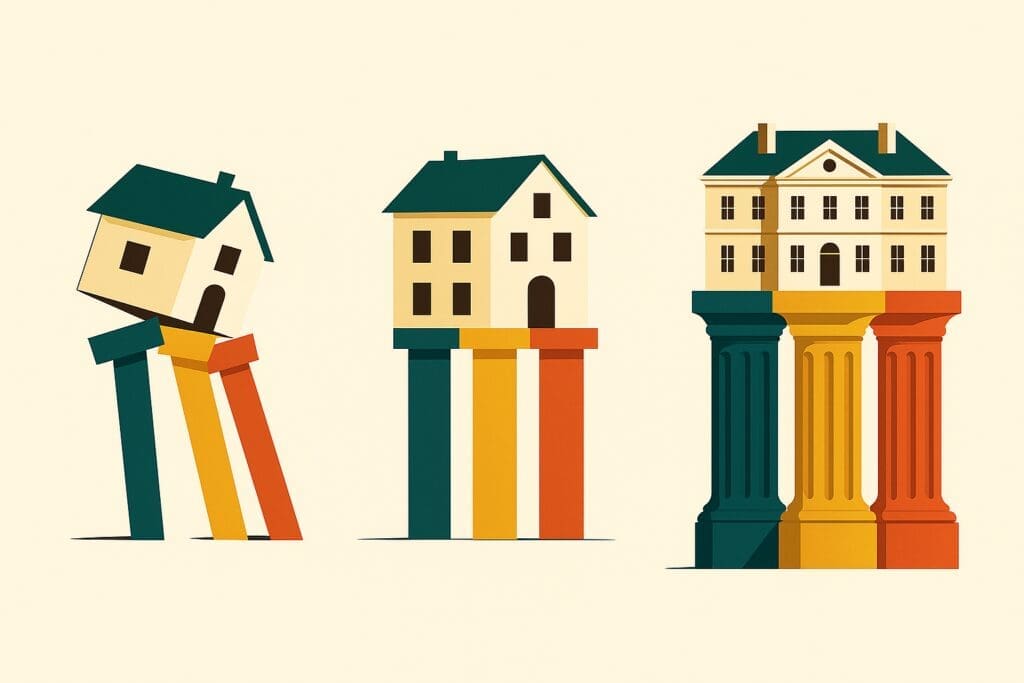
You run a creative business, after all, and these are the things you create. They are the foundational pillars that shape your business, how it’s perceived, and what it’s capable of achieving. Each one plays a different role. Each one shapes the others. They are invariably interconnected, and together, they form the foundation of a business that can grow creatively, sustainably, and profitably.
When all three pillars are strong and aligned, everything starts to click.
- Your projects feel more cohesive.
- Your communication becomes more efficient.
- Your clients become advocates.
- Growth feels less like guesswork and more like strategy.
- Your systems and operations start working from a place of strength rather than efficiently running (and probably increasing) misalignment.
It’s the difference between doing great projects and building a business that’s equipped to carry them.
When your pillars are out of sync, the gaps multiply. Growth feels unpredictable. Revenue is inconsistent. Processes feel clunkier or more stressful than they should. The business doesn’t reflect the level of work you’re putting into it, and you’re left carrying all the weight yourself because the structure isn’t working.
So building a strong foundation is the key to building a profitable, fulfilling, and sustainable business that supports your creativity and growth. This is where we begin.
Design
Design is where everything begins. It’s your craft. Your vision. The reason you built this business in the first place. It’s also the most visible expression of what you do, and the one most people assume defines your value.
But inside a business, design doesn’t stand on its own. It’s only as effective as the experience that carries it and the brand that contextualizes it.
No matter how strong your creative work is, it lives within a broader system. It’s affected by how information flows between client and designer. By how decisions are made and documented. By how your business communicates expectations, boundaries, and authority. It’s shaped by the way you lead, and the way your business shows that leadership before a single idea is shared.
When your client experience is unclear or inconsistent, your design ends up compensating. It has to carry the weight of confusion or rebuild trust that should have been established long before the presentation. When your brand is underdeveloped, your design work has to do more to prove its value, over-explaining, over-justifying, overcompensating.
But when all three pillars are aligned, your design work gains power. It becomes easier to explain, easier to sell, and easier to deliver. You stop using design to solve problems that aren’t design problems. You stop bending your creative to meet expectations that were never clearly set. And you start designing in a business that was actually built to support it.
That’s the first key shift: from design as the center of everything, to design as one part of a cohesive, creative structure, no longer doing all the work on its own.
Client Experience
Client experience is how your work feels to the people living through it. It’s the lived reality of your brand.
It’s not just what you deliver. It’s the emotional arc of the project. It’s the trust you build early on. The excitement you create when ideas are first shared. The sense of being seen, understood, and taken care of throughout the process.
Clients don’t rave about your timelines or your file organization. They rave because they felt confident in your hands. Because you made things easier. Because the process made them feel something—joy, calm, clarity, pride.
Those feelings don’t come accidentally. They’re the result of an experience purposefully designed.
And like any good design, they’re built with structure: clear expectations, consistent communication, thoughtful touch-points, and a system that anticipates what clients need before they have to ask.
When the experience is inconsistent or undefined, breakdowns start to happen. Clients second-guess decisions. Questions pile up. Your process gets interrupted by emotions you didn’t plan for. And over time, the value of the design starts to erode because the experience isn’t consistent with the brand promise, and emotions overwhelm the value.
But when the client experience is intentional and aligned with your design and brand, it elevates everything. It builds loyalty. It earns trust. It creates advocates who remember how you made them feel (and tell everyone they know).
This is what exceptional service actually looks like. It’s not about bells and whistles, but real emotional resonance. The right feeling, delivered at the right moment, throughout the entire journey.
Brand
Brand is the story your business tells; visually, verbally, emotionally.
It’s the thread that ties everything together: your values, your perspective, your tone, your aesthetic. It’s what clients see before they ever meet you, and what lingers long after the project is done.
A strong brand doesn’t just look good. It gives context to your work. It shapes how people interpret what you do, what it costs, and who it’s for. It sets expectations before the first call and reinforces the feeling people have throughout the experience.
When your brand is clear, your design doesn’t have to justify itself. Your client experience feels more intentional. The entire business holds together with more ease and authority because the message is consistent across every platform, every touchpoint, and every project.
When your brand is vague or out of sync, even the best design work feels harder to communicate. You end up over-explaining. Your leadership gets questioned. You attract the wrong clients because they don’t know what you stand for. You lose control of how your business is perceived because the signal is muddled.
The important shift here is seeing your brand not as packaging, but as part of your creative and business ecosystem. It’s something that’s derived from your unique point of view and then consistently integrated into every touch-point, across every project.
When your brand, client experience, and design are aligned, your business gains identity. Not just a style, but a presence. A point of view. A way of showing up that makes your work instantly recognizable and easily referable.
So Where Do You Go From Here?
If you’re reading this and something clicked, it probably means you’re ready for the next level.
If you’re like most designers (myself included), early growth is reactive and improvised. But as the business matures, the gaps between what you create and how it’s supported start to show—in the process, in the communication, in the perception of value, and in your own experience running it. At some point, the improvised foundation you built stops being able to support the higher level of work you want, and you stop being able to move forward. That’s when you hit a plateau.
If that’s where you find yourself, start here:
- Look at the way you design. Does the process support your best work, or is it getting in the way?
- Look at your client journey. Are you purposefully shaping the emotional experience, or reacting to it?
- Look at your brand. Is it expressing what your work stands for, or do you sound like everyone else?
When design, client experience and brand are clear, connected, and intentionally expressed through confident leadership, growth becomes easy and inevitable. It becomes profitable. And it becomes sustainable.
And that’s what I’m here to help you create. If you ever want to learn more, just click here to get in touch.